Mexico has a long history of perpetuating violence against its people to maintain neoliberal and US supremacist government structures. Recently, Mexican citizens have become more agitated by said violence. The events that took place in Iguala in September sparked a larger movement to end the corruption and brutality in Mexico, but it is important to view these as problems US residents actively participate in.
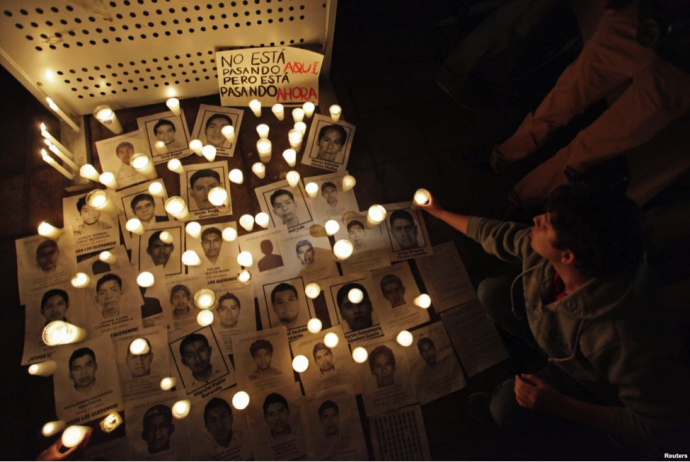
Several students from a small, rural, teacher’s college in Ayotzinapa protested the government’s stances on education -among other things- in the small town of Iguala in the Mexican state of Guerrero. Under the order of Guerrero’s governor, Ángel Aguirre Rivero, police fired at the student demonstrators, killing 6 and kidnapping 43. The police handed over the 43 victims to a local drug cartel and the family members of the students searched for their loved ones for several days, resulting in the finding of mass graves of victims of cartel violence, but not the 43 students. It was recently discovered that the 43 students were burned alive by a drug cartel and their ashes dumped into a river. The incident sparked national protests against Mexico’s violence, corruption and human rights violations. The protests escalated, resulting in the arrest of José Luis Abarca and his wife, the burning of Guerrero’s state capitol building, as well as the National Palace in Mexico City, one of the most historic government buildings in the country. Although this last incident has received the most international attention, it is part of a larger trend of violence against the Mexican people, and thousands of Mexicans have been tortured and murdered without justice. As a son of Mexican immigrants, who grew up listening to the stories of family friends who died as victims of the violence perpetuated by the government and the cartels, I feel the need to take a stance on this issue. Given that the causes of the violence in Mexico are transnational in nature, it is important to take a transnational approach to alleviate violence.
First, it is important to recognize that drug cartels and the governments of the US and Mexico as entities that work with each other in order to maintain the status quo in Mexico. US citizens must realize that our government continues to push for neoliberal reforms (denationalizing of Mexican oil, creation of NAFTA and the TPP are among some of these neoliberal reforms) that systematically oppress Mexican people. The US government is actively involved in, and supports the political corruption in Mexico and the violence against leftist demonstrators that question neoliberalism and US hegemony. The US is the number one consumer of narco supplied drugs, and the main supplier of armed weapons for the drug cartels. American citizens tend to dismiss the political situation in Mexico with the racist notion that Mexicans are incapable of forming a democracy and that they themselves are at fault for their lack of freedoms. But the violence in Mexico is not simply a product of internal problems; rather, it is a product of US dominance in the Global South. The neoliberal reforms and the violence in Mexico serve to maintain an American, consumer based lifestyle where cheap goods (including narco-supplied drugs) are available to US consumers while Mexico’s workers, citizens and environment are exploited.
The Ayotzinapa movement is a huge presence within Mexico, but since the US is so active in the country’s violence, the movement would be more productive if it became a transitional effort for peace, justice, and democracy in Mexico. Aside from a handful of Latin@s on campus who have a more than obvious stake in the matter, the Vassar activist community has been largely apathetic regarding the situation in Mexico. Political movements within Vassar’s campus have assumed very trendy trajectories. The BDS and animal rights movements are gaining a lot of traction here, as well as in many other colleges, and while these movements are incredibly important, there is an inherent hypocrisy within the Vassar’s political bubbles when people are very vocal about BDS and veganism, yet continue to experiment with fashionable narco-supplied drugs without realizing the political implications of these actions. Vassar students benefit from anti-Mexican US foreign policy and it is clear that it is not trendy to care about Mexican bodies. The majority of Vassar students continue to be apathetic about issues in Mexico because showing concern significantly disrupts the consumer based way of life to which they have grown accustomed.
Mexicans are calling for transnational solidarity efforts to alleviate state sponsored violence in corruption, but it is vital for US to avoid taking a white saviorist approach to the movement. What can we do as US residents? Mexican activists and journalists risk assassination when they are critical of the government and the drug cartels, while US residents have the privilege of being able to mobilize with lower chances of being killed. Although we must be critical of this privilege, it grants us the ability to work within and ask our government to end the war on drugs and neoliberalist policies that inhibit progress in Mexico. Additionally, the US federal government is largely uncritical of the Enrique Peña Nieto’s presidency. US activists must join Mexicans in the call for the resignation of Enrique Peña Nieto, as well as the other politically corrupt individuals that plague Mexico’s federal, state and municipal governments. Finally, many privileged Vassar students partake in the consumption of narco-supplied drugs, and by doing so, they are supporting the narco and state sponsored violence within Mexico. In order for Vassar’s campus to take a more active role against violence experience abroad, we must be critical of what we chose to consume, and where our money is going. As a Chicano student, with a great deal of my family still in Mexico, I am appalled by the lack of concern for Mexican bodies, and would like to see a campus that is more concern about our actual well-being instead of the exploitation of my people and culture.
Nothing was really being done on campus until MEChA de Vassar organized a vigil concerning to mourn the deaths of the 43 students of Ayotzinapa, as well as the thousands of victims of the Drug War initiated by the US and Mexico. The event will take place on Thursday, November 20th, 7:00pm at the Library Lawn. This is only one event that attempts to show solidarity with organizers in Mexico, but again, it’s important to keep the movement going, and organize against the war on drugs and the neoliberalist policies that the US upholds in Mexico.
For access to the Facebook Event Page on the vigil, please click here.