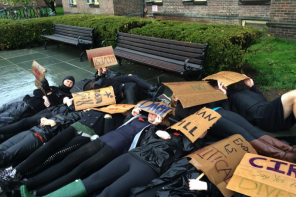
The fine line between ignorance and negligence is broken in favor of the latter during Israeli Apartheid Week at Vassar, where students possess the resources with which to examine the truth of the Israel/Palestine “conflict.”
Professor Sa’ed Atshan is a Postdoctoral Fellow in International Studies at Brown University’s Watson Institute, and a Lecturer in Peace and Justice Studies at Tufts University. He holds a PhD and an MA in Anthropology and Middle Eastern Studies from Harvard University. He has worked for the American Civil Liberties Union, the United Nations High Commission on Refugees, Human Rights Watch, Seeds of Peace, and the Palestinian Negotiations Affairs Department, and is a member of Al-Qaws, an organization that promotes LGBTQ Palestinian rights.
On March 3rd, Professor Atshan came to Vassar and delivered a talk, “On Hope and Heroes: Nonviolence and Resilience in Israel/Palestine,” to a group of over fifty students and faculty. Atshan centered the lecture and Q&A on his personal heroes, who have dedicated their lives to advocating for justice in Israel/Palestine.
Through photographs, personal stories, and videos, Atshan illustrated how roughly 500 Israeli checkpoints inhibit movement and communication for Palestinians in the West Bank, a region a quarter the size of New Jersey. Palestinians confront roadblocks, interrogations, and ID-verifications daily while Israeli Defense Forces (IDF) soldiers monitor from towers. Adults and children carry identification passes to move through their own territory. At the overcrowded, stringently fenced checkpoints, pregnant women and the elderly have fainted and died. Children often urinate and defecate in place due to the excessive delays. Atshan cited a group of Palestinian workers whom, for a 9 a.m. job, wake up at 3 a.m. everyday to allow for the hours of waiting and questioning. A photo displayed a cluster of commuters standing in a literal cage, waiting to pass. IDF soldiers lurked in most photos, often restraining mourners or resisters, like 11-year-old twins crying for their mother who was being arrested and thrown into a truck, and a child peeing his pants during his arrest (Israel is the only country in the world that tries children in military court). IDF soldiers were also pictured and videoed guarding the segregation of highways, roads, and villages.
The West Bank barrier, a structure far longer and taller than the late Berlin wall, winds and weaves throughout the borderland, dividing Jewish communities, Palestinian communities, and resources into finely zoned departments. Israeli settlers bathe in pools atop former forestland while Palestinian families carry water, in buckets, uphill, on foot. Israel maintains control of the majority of water aquifers and disproportionately distributes resources to Jewish settlers. The wall separates Palestinian families and neighbors in such a way that a five-minute walk becomes a three-hour ordeal. The purpose of the wall is “security,” which even for the definers signifies Jewish domination of land and resources.
In Israel proper, a set of laws divides “citizens” from “nationals.” The Palestinians who stayed through the 1948 expulsion of non-Jewish Arabs from Israel do enjoy citizenship, but only the nationals– the Jewish Israelis– are entitled to certain privileges, especially in regards to housing and schooling. Intermarriage is discouraged and made nearly impossible, and same-sex marriage is illegal. Often receiving the demolition bill for the destruction of their own homes, Arabs are expelled daily from their homes in East Jerusalem to make room for Jewish settlers.
The occupation of the West Bank and Gaza, the construction of settlements in the West Bank, and the annexation of East Jerusalem are all illegal under international law.[1]
Israel received three billion dollars a year from the United States. The IDF teargas canisters on which a bereaved grandmother laid flowers in one photo all said “USA” on the bottom.
Atshan made clear his dedication to secularism and to progressivism. For him, an Arab Christian and a self-identified “flaming queen,” theocratic rule offers little. He lamented not only the “PEPs” in Israel/Palestine debates (progressive except for Palestine) but also the “POPs” (progressive only for Palestine). “Imagine,” he said, “if the US put a cross on its flag and declared itself a white Christian nation.” He imagined a flag which encompassed the Star of David, the cross, and the star and crescent.
Two thirds into the lecture, the Vassar J Street U board left for their weekly board meeting. But how could a solution be brought about by discussing the “conflict” with American peers in the Retreat in the place of listening to a queer Palestinian who has lived through the struggle himself?
Students for Justice in Palestine and Jewish Voice for Peace have emerged as the only organizations to label the occupation of Palestine as “apartheid” and to advocate Boycott, Divestment, and Sanctions (BDS) against Israel. J Street U seeks to involve the United States deeper into the conflict as an arbitrator between the two “sides,” but as Atshan stressed, this “conflict” is not a fight between two states, but rather a life or death struggle between one of the largest militaries in the world, funded by the world superpower, recognized internationally, with bureaucracy and infrastructure, against a stateless, restricted, and impoverished people. The United States is coming in on a century of dousing its fingers in the Middle East. If it wants to level the negotiating table, it ought to halt its funding of the occupation.
Atshan emphasized international BDS as the most effective form of nonviolence. He listed a plethora of nonviolent organizers in Israel/Palestine, comprising Jews, Israelis, Palestinians, Christians, Quakers, Americans, Bedouin, and Muslims. Most have been subject to beating, arrest, and incarceration. The list includes:
Eitan Bronstein, Zochrot
Yonatan Shapira, Combatants for Peace
Yitzhak Frankenthal, Bereaved Parents Circle
Bruno Hassar, Neve Shalom/Wahat al-Salam
Rina Rosenberg, Adalah
Mariam Abu Rakeek, Desert Daughter
Sahar Vardi, New Profile
Reverend Naim Ateek
Hedy Epstein, a Holocaust survivor
Jean Zaru, Ramallah Friends Meeting
Mubarak Awad, Nonviolence International
Fadi Quran, Palestinian Freedom Riders
Matan Cohen, Anarchists Against the Wall
These organizations cover issues ranging from Palestinians protesting segregated roadways to ex-IDF soldiers speaking out against apartheid to Bedouin women’s economic resistance.
If there was one weakness to Atshan’s lecture, it was his belief in the “inevitability” of Palestinian redemption through nonviolence.
Vassar professors received hate mail due to their association with the event.
Ten years ago, Athsan explained, the fight on college campus was to prove that Palestinians exist. Then it was to prove that Palestine exists. Then that the occupation exists. Today, Students for Justice in Palestine fights to prove that Israeli apartheid exists.
[1] Resolution 478, UN Security Council http://unispal.un.org/UNISPAL.NSF/0/DDE590C6FF232007852560DF0065FDDB