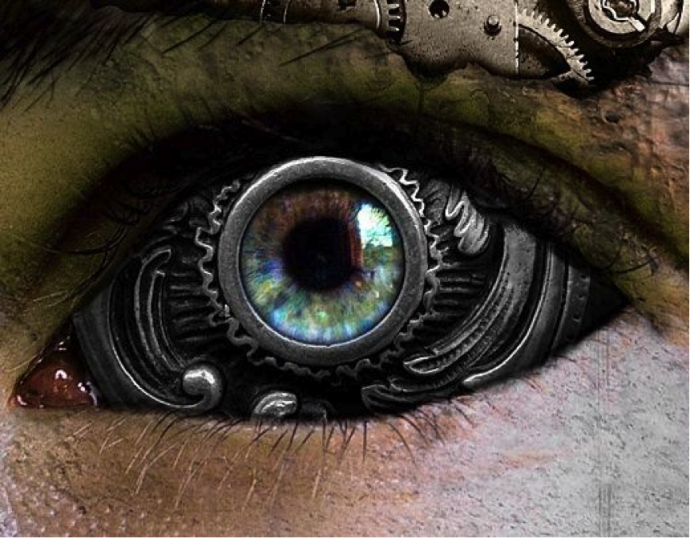
The cyborg is our ontology; it gives us our politics. The cyborg is a condensed image of both imagination and material reality, the two joined centers structuring any possibility of historical transformation.
– Donna Haraway, “A Cyborg Manifesto: Science, Technology, and Socialist Feminism in the Late Twentieth Century” (1983)
This mythic time which feminist theorist Donna Haraway wrote about in 1983 is not so far from our present. We are, and some would argue, have always been cyborgs, forever extending our minds into the tools and technologies around us while simultaneously being shaped by them.
What is a cyborg? A cyborg (short for “cybernetic organism,” thank you Wikipedia) can be an entity with both “organic” and “biometric” parts. Yet, there are a variety of interpretations of this definition, as there is a wide spectrum of fusions between so-called “natural” bodies and so-called “unnatural” ones. I am not talking exclusively here about the mainstream cyborgs in The Terminator or I-Robot; the scope of ‘cyborg’ technologies includes cochlear implants, Google Glass, iPhones, or even your Nike shoes. Seriously, think of the engineering, physics, and mathematical algorithms that went into the design of Airforce 1 sneakers. If to be a cyborg is to use external and ‘unnatural’ means to enhance one’s biological capabilities, it is not so hard to realize this cyborg part of ourselves. Consider me, for example: As I write this I am using the computer as a way to communicate my thoughts, as a platform for extending the contents of my mind to a number of readers. Luckily, I can see the page in front of me because of my contact lenses, a modification without which I would be seriously lost and headache-y. And look! I just transcended thousands of miles to text a friend from Rome, all the while feeling healthy because I took my women’s daily vitamin! Huzzah, I’m a cyborg!
In light of this, it might be futile to reiterate the numerous headlines and internet lists (the irony!) warning that technology is taking over and is causing us to retreat into the alienated, cold world of our smartphones, ‘destroying our social skills’ and ‘dehumanizing’ us. Maybe your parents send you these articles in the hopes that you will stop texting at the dinner table. Maybe you should stop texting at the dinner table, you stereotypical millenial. My point here is not to defend your parents, but rather to highlight the brighter, more optimistic side of technological development. I want to look at a flip-side to the fear of cyborg take-over in the mainstream media.
Many people think that cyborgs are not only mechanisms for control but will be used to create the means to channel evolution along new technologically-mediated paths, ones that will inevitably lead to human extinction. This is obviously an intimidating prospect which explains much of the techno-phobia of our generation.
This specific generalization of the cyborg is obviously problematic. It implies that technology, and the people who use it, are inherently controlling, dominating, and oppressive-led by blind profit potential instead of positive ideals of social change. The contemporary futurist discourse envisions the cyborg as an uncontrollable enemy of humankind – an all-powerful product of scientific development which will eventually top humans on the social hierarchy.
But doesn’t this idea of a cyborg seem to fit all too well into current hierarchies of identity? Wouldn’t this type of cyborg just surpass humans to become the new one percent, with infinitely higher intelligence and dangerously lower emotional capacities? If we consider the current pioneers of robotics (i.e. IBM, Google, US Department of Defense) and the amount of power they exert over technological development, this dismal fate indeed seems plausible. But Haraway isn’t convinced: “The main trouble with cyborgs, of course, is that they are the illegitimate offspring of militarism and patriarchal capitalism, not to mention state socialism.”
However (and here is where those concerned with identity politics and social activism should pay close attention if you are growing weary with all this techno-terminology), Haraway provides an alternative framework that re-conceptualizes the aims of transhumanism-an international cultural and intellectual movement that looks at and questions the ways emerging technologies can enhance human potential. Rather than reproducing a harmful and exclusive hierarchy of identity (i.e. machines over humans over animals), artificial boundaries (i.e. human vs. machine, male vs. female, human vs. animal), and limiting categories of identity (i.e. race, gender, social class), Haraway utilizes the cyborg as a heuristic for understanding and celebrating our hybrid nature. This is not meant to suggest that we have transcended current identity politics or to propose the cyborg as a post-racial or post-gender entity. We can, however, use the cyborg of Haraway’s imagination to interrogate anxiety-ridden distinctions between human and animal, organism and machine, and the physical and nonphysical – historical dichotomies of identity which have been systematic to practices of domination over the other (i.e. women, people of color, the environment, workers, animals). In recognizing the fusions of human and machine or of natural and unnatural elements in our own lives, we might be empowered to confront restrictive labels that cannot fully capture who and what we are.
While cyborgs might be the illegitimate offspring of patriarchal capitalism, we should remember that “illegitimate offspring [cyborgs] are often exceedingly unfaithful to their origins”. Their fathers, after all, are “inessential.” Instead of embedding cyborgs in a violent conception of identity politics, we should instead acknowledge our agency in technological creations, taking “pleasure in the confusion of boundaries” but also “responsibility in their construction,” in Haraway’s words. Cyborgs have the potential to undermine essentializing structures; in their wonderful combinations of human, machine, natural, and unnatural parts, they refuse to conform, blurring categories of identity which never quite do us justice.
Allowing the image of the cyborg as an enemy to humans denies the dynamic symbiosis of humans and our technologies. Instead of outright rejecting technology as a mode of domination, we should consider their origins and rewrite their potential. For example, we can reconceptualize texting as not only an unnatural obstacle to social interaction, but as an alternative and powerful mode of communication-a method of subverting the constraints of space and time when change needs to happen now. We need to recognize that it can be used in both ways simultaneously. Let’s take a page from Haraway’s book and celebrate the existence of hybrid entities, ourselves included. Cyborgs provide a critical challenge to dualisms and antagonisms which are essentialist and incapable of accounting for our partialities, contradictions, and inevitable tensions.
The robot of impending human extinction ironically confronts norms of categorization and classification, perhaps setting the stage for a new identity politics. Why not think about the positive potential of cyborgs, rather than their destructive capacities? Haraway cites Joanna Russ, Samuel R. Delany, and Octavia Butler as captivating feminist science-fiction writers whose work contains cyborg characters that are “rich with boundary transgressions.” While our technologies inevitably shape us, we have an equal ability to shape their trajectory. Instead of an enemy, consider the possibility of a cyborg as a wonderfully hybrid creature, a friend in the realm of communal species. Or consider the idea you might already be one.